
PESTEL Analysis of the European Union (2026): who holds the lever
A PESTEL analysis of Europe in 2026 — a Hormuz energy shock, two ECB rate hikes, a 15% US tariff ceiling, and the cells where Brussels holds the lever versus the 27 capitals.
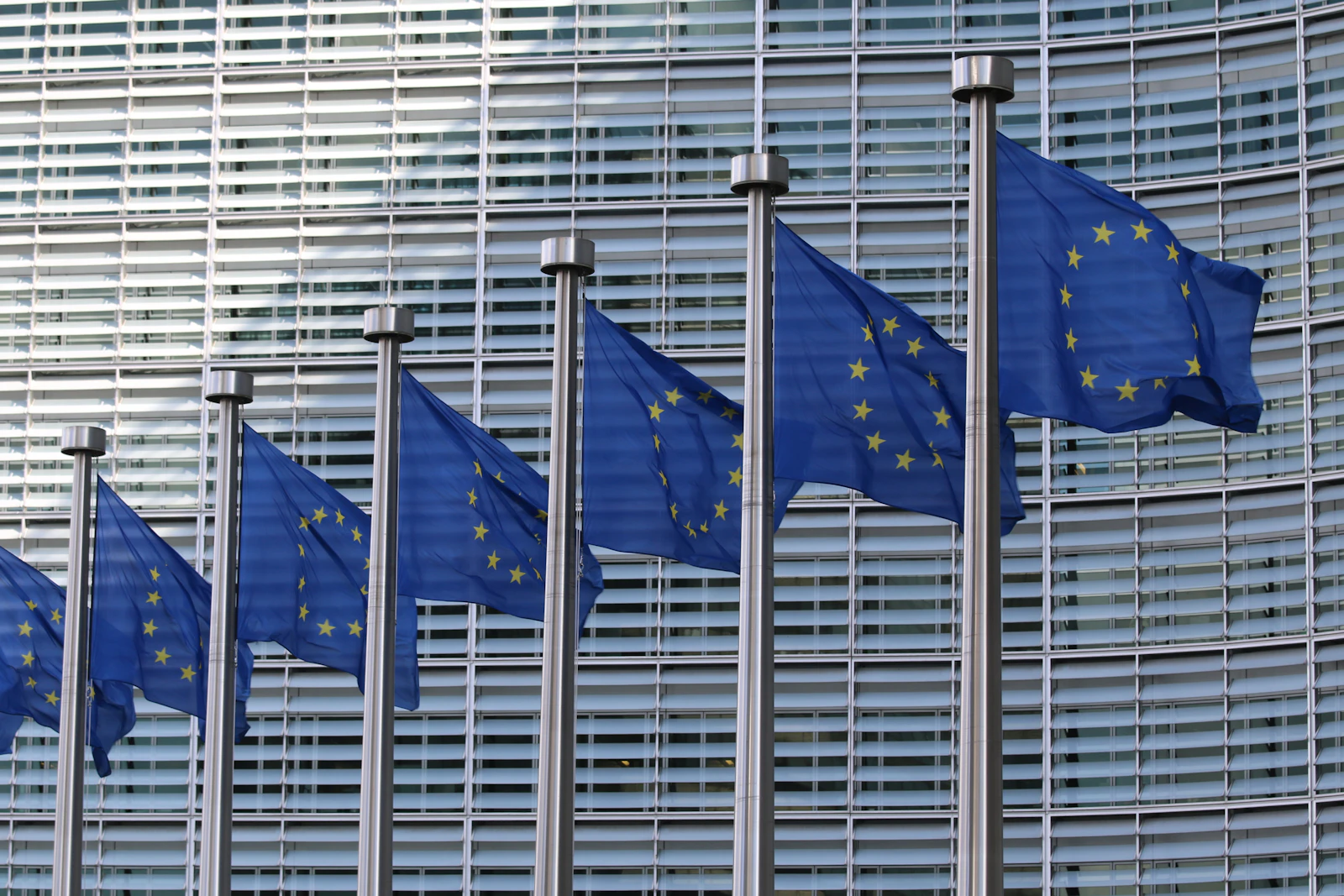
Every PESTEL of a country makes one silent assumption: that there is a government at the other end of each cell. Score the Political force and you are scoring a cabinet. Score the Economic force and there is a finance ministry and a central bank that answer to the same electorate. The six cells may disagree with each other, but they are all about the same state.
The European Union is the one subject for which that assumption is false, and September 2026 is the month that makes the failure visible. The forces that moved most this year — a Strait of Hormuz closure that reset the inflation outlook, two ECB rate rises, a tariff deal with Washington, a sixteen-month deferral of the AI Act, a carbon border tax going live, a migration regime switching on — were all pulled from Brussels or Frankfurt. The forces where the money actually sits — fiscal stimulus, defence procurement, wages, energy mix — were pulled, or not pulled, in twenty-seven capitals.
PESTEL scans six external macro forces — Political, Economic, Social, Technological, Environmental, Legal — around an entity and asks whether each is favourable or adverse. For the EU that question has a prior one: favourable according to whom, and adverse at which level? This page is the fifth in a country series, and it is the first where the subject is not a country. The PESTEL analysis of the USA (2026) found one force holding up the other five. Canada found one force rewriting the other five. France found the cells splitting by constitutional instrument, and Germany found six cells that were all early. The EU shows something none of those can: six cells governed by different governments.
Position being analyzed
The decision this analysis is built for: a firm deciding whether to treat "Europe" as one market for a 2026-27 capital, hiring or pricing decision — and, if not, which parts of the scan it can settle once and which it has to settle twenty-seven times.
That is the live question because the 2026 shocks arrived at Union level and the 2026 responses are split. A scan that treats the EU as a state overstates what Brussels can do about the two cells it does not control, and understates how fast it can move on the four it does.
| Indicator | Latest reading | As of |
|---|---|---|
| EU real GDP growth, 2026 / 2027 forecast | 1.1% / 1.4% (euro area 0.9% / 1.2%) | Commission, 21 May 2026 |
| Euro-area HICP inflation, 2026 / 2027 / 2028 | 3.0% / 2.5% / 2.1% | ECB staff, September 2026 |
| ECB deposit facility rate | 2.50%, after +25bp on 11 June and +25bp on 10 September | 10 September 2026 |
| Strait of Hormuz seaborne oil / LNG flows | −15% / −20% | Commission, spring 2026 |
| EU gas storage fill | 57.1% — lowest on record for the date | 1 August 2026 |
| US tariff ceiling on most EU goods | 15% all-inclusive; steel and aluminium still 50% | applied from 1 July 2026 |
| EU general government deficit / gross debt | −3.5% of GDP (2026) / 85.3% (2027) | Commission, spring 2026 |
| SAFE defence loans disbursed | ~€8.4bn of a €150bn cap (~5.6%) | 12 August 2026 |
| CBAM certificate price, Q2 2026 | €75.28 / tCO₂e | published 6 July 2026 |
| EU population, 1 January 2026 | 452.0 million, +705,756 on the year | Eurostat |
Political — a Council that got its unanimity back
The single largest political fact in the EU's 2026 is a national election, which is the first hint that the Political cell does not belong wholly to Brussels.
On 12 April 2026 Hungary's Tisza party under Péter Magyar defeated Viktor Orbán's Fidesz, taking 141 of 199 seats on 53.2% of the list vote against Fidesz's 52 seats on 38.61% — a two-thirds majority and the end of a sixteen-year government. The Magyar government took office on 13 May 2026. For the Union the significance is arithmetical rather than ideological: the European Council decides sanctions, enlargement, foreign policy and the next long-term budget by unanimity, and for most of the previous decade one member state's veto was the binding constraint on all four. That constraint was removed by 3.3 million Hungarian voters, not by any EU institution.
The institutional layer is running on a slower clock. The Commission's proposal for the 2028–2034 budget — almost €2 trillion, or 1.26% of gross national income — was tabled on 16 July 2025; on 16 June 2026 the Council adopted partial negotiating positions on its two biggest new instruments, the national and regional partnership plans and the European Competitiveness Fund, while Parliament is pushing for roughly €200 billion more. The regulation must be adopted unanimously by all 27 and consented to by Parliament, on a timetable that runs to 2028.
And the member-state layer is where the volatility lives. France's fiscal position and Germany's three September state elections are the Political cells of the France and Germany pages, and they are not repeated here, because that is the point: they are not the Union's Political cell. They are inputs to it.
Score: favourable at Union level, high volatility at member-state level — and the two do not net.
Economic — one central bank, twenty-seven treasuries, one war
The Economic cell is the one where the split is clearest, because the euro area has exactly one monetary policy and no fiscal policy.
The monetary half moved decisively. The ECB raised all three key rates by 25 basis points on 11 June 2026 — its first increase in three years — taking the deposit facility rate to 2.25% from 17 June, and stated plainly that "the war in the Middle East is generating inflation pressures." It held on 23 July and raised again on 10 September, to a deposit rate of 2.50% and a main refinancing rate of 2.65%. The September staff projections that accompanied the second hike put headline inflation at 3.0% in 2026, 2.5% in 2027 and 2.1% in 2028, with 2027 and 2028 both revised up from June, and core inflation at 2.5%, 2.6% and 2.3%.
Growth is not the problem. The Commission's 21 May 2026 Spring forecast cut EU growth to 1.1% for 2026 and 1.4% for 2027 (euro area 0.9% and 1.2%) from the autumn's 1.2% and 1.4%, and lifted inflation by a full point to 3.1% and 2.4% (euro area 3.0% and 2.3%). By September the ECB kept 2026 at 0.9% but revised 2027 up to 1.4%, noting the euro area had proven "more resilient to the effects of the conflict in the Middle East than previously expected." Unemployment sits near 6.0% for the EU and is projected to drift down to 5.9% by 2028.
| Forecaster | Euro-area GDP 2026 | Euro-area GDP 2027 | Euro-area inflation 2026 | 2027 |
|---|---|---|---|---|
| European Commission, spring (21 May 2026) | 0.9% | 1.2% | 3.0% | 2.3% |
| ECB staff, September 2026 | 0.9% | 1.4% | 3.0% | 2.5% |
The fiscal half is not a Union number at all. The Commission's aggregate — a deficit of 3.5% of GDP in 2026 and 3.6% in 2027, gross debt rising from 82.8% in 2025 to 85.3% in 2027 — is the sum of twenty-seven budgets that Brussels can surveil but not write. The ECB is explicit about where the impulse comes from: defence and infrastructure spending, "primarily from Germany," adds about 0.5 percentage points cumulatively to growth over 2025–28, and the fiscal stance loosens by about 0.5 points of GDP in 2026 before tightening in 2027–28. Whether that German money arrives on schedule is the subject of the Disbursement Gap on the Germany page — it was running at 28% of its 2026 budget by April — and nothing at Union level can accelerate it.
Score: adverse on inflation, neutral on growth, and the lever is split — monetary policy is exclusive to the ECB, fiscal policy is not the Union's to score.
Social — the cell the Union barely governs
The EU's population reached 452.0 million on 1 January 2026, up 705,756 on the year, and every unit of that growth was migration: natural change is negative and has been for years. The median age was 44.9 years on 1 January 2025; the old-age dependency ratio was 33.4% at the last full reading. In 2024 almost six million people immigrated to EU countries, 4.2 million of them from outside the Union.
Those are Union-wide numbers, and they describe a Union-wide problem. The instruments that act on it are almost entirely national. Employment, social policy, pensions, minimum wages and labour law are areas where the treaties give the EU a coordinating or supporting role and the member states the decisive one — which is why the Germany page can cite a €13.90 statutory minimum wage and a 22.7% skilled-labour shortage as live costs, and this page cannot cite a European equivalent, because there is none.
The one Social instrument the Union does hold switched on this year. The Pact on Migration and Asylum, ten binding legislative acts adopted in 2024, started applying in all member states on 12 June 2026 after a two-year transition, with common screening at the border, faster asylum and return procedures, and a solidarity mechanism between states under pressure. It is a genuine Union competence and a genuine change — and it governs the procedure for the arrivals, not the labour market they arrive into.
Score: adverse, low volatility — and almost entirely outside the Union's reach.
Technological — a regulation the Union moved, and a fund it has not yet built
Technology is the cell where the EU's reputation and its 2026 record diverge most.
The reputation is for regulating. The record this year is for deferring. The AI Act's high-risk obligations were due on 2 August 2026. On 16 June 2026 the European Parliament endorsed the Digital Omnibus on AI by 423 votes to 57 with 174 abstentions, and the Council gave final approval on 29 June: stand-alone high-risk systems under Annex III — hiring tools, credit scoring, biometric identification — now have until 2 December 2027, and AI embedded in regulated products under Annex I until 2 August 2028. The Article 50 transparency duties still applied from 2 August 2026; the watermarking obligation on providers moved to 2 December 2026. A sixteen-month change to the continent's flagship technology law, made in one legislative cycle, with no national parliament involved.
The investment side is the opposite story. The proposed European Competitiveness Fund exists as a Council negotiating position of 16 June 2026 inside a budget that does not start until 2028. Until then, technology investment in Europe is national money — Germany's €500 billion fund lists research and development among its weakest areas of progress — and private money that the ECB describes as constrained by "the past appreciation of the euro and higher US tariffs."
Score: neutral — favourable on regulatory clarity, which the Union controls; unrealised on capital, which it does not.
Environmental — the shock nobody chose, and the price only Brussels sets
Two things share this cell in 2026 and they are governed at opposite levels.
The shock is the Strait of Hormuz. The war that began on 28 February 2026 with US and Israeli strikes on Iran led to the strait being declared closed on 4 March; a US naval blockade of Iranian ports ran from 13 April to 29 May; a memorandum to end the war was signed on 17 June, Iran re-closed the strait on 20 June, and the ceasefire collapsed on 8 July after attacks on commercial vessels. As of September shipping remains severely disrupted. Before the crisis roughly 25% of the world's seaborne oil and 20% of its LNG transited the strait; the Commission's spring forecast put the cut to flows at about 15% and 20%, with gas prices up 50% and crude up 65% between 27 February and 29 April. Brent peaked at $126. By 20 August Dutch TTF gas was back above €65/MWh, its highest since March, up about 130% on the year, and EU storage had reached only 57.1% on 1 August — the lowest reading for that date on record — against a 90% target that the Union has already allowed to be met anywhere between 1 October and 1 December.
Where the lever sits is the instructive part. The storage target is a Union regulation. The joint purchasing platform is a Union instrument. But Article 194 of the treaty reserves each member state's choice of energy mix to that member state — so the exposure to Hormuz LNG is a national fact that varies from a coal-and-nuclear Poland to a gas-dependent Italy, and the Union can set a fill level without being able to change what is being filled.
The price the Union does set is carbon. The Carbon Border Adjustment Mechanism entered its definitive phase on 1 January 2026. The Commission published the first official certificate price on 7 April — €75.36 per tonne for Q1 — and €75.28 for Q2 on 6 July, tracking the EU ETS, where allowances traded around €82 at the end of August. Certificate sales open on 1 February 2027 and the first surrender, covering 2026 imports, is due by 30 September 2027. Every importer of steel, cement, aluminium, fertiliser, hydrogen or electricity into the Union is now accruing a 2026 liability at a price no national government can alter.
Score: adverse, high volatility on energy — with the exposure national and the carbon price exclusively Union.
Legal — the cell where 2026 moved fastest
Almost everything that changed in the EU's legal environment this year changed at Union level, on Union timetables.
The largest is trade. The Turnberry political agreement of July 2025 capped most US tariffs on EU goods at an all-inclusive 15% in exchange for EU tariff elimination on most US industrial goods and twenty agricultural quotas. Then on 20 February 2026 the US Supreme Court held 6-3 that the IEEPA tariffs were unlawful. The US replaced them with a 15% Section 122 tariff on 24 February, which expired by statute on 24 July and was replaced by Section 301 duties of 10 to 12.5% for most economies — and through all of that, EU goods stayed where the deal put them. Council and Parliament struck the implementing agreement on 20 May 2026; the regime applied from 1 July 2026 and runs to the end of 2029, with autos at 15% instead of the 25% Section 232 rate other exporters pay, steel and aluminium still at 50%, and a clause allowing the Commission to suspend the EU's concessions if the US is still charging above 15% on EU steel and aluminium derivatives on 31 December 2026.
Add the AI Act deferral, CBAM's definitive phase, the Migration Pact's entry into application, and the ECB's two decisions, and the pattern is unmistakable: the Union's legal cell in 2026 is a list of dated, enacted, continent-wide changes, each made by an institution that did not need to ask a national parliament. That is what an exclusive or Union-level competence looks like in a scan — fast, uniform, and binding on 452 million people at once.
Score: favourable on predictability, low volatility — the cell where the Union is most like a state.
PESTEL scorecard for the European Union, September 2026
| Force | Direction | Volatility | The single fact that sets it | Who holds the lever |
|---|---|---|---|---|
| Political | Favourable (Union) / volatile (states) | High | Hungary's 12 April election restored Council unanimity; MFF talks run to 2028 | Both — and they do not net |
| Economic | Adverse on inflation | High | Two ECB hikes to 2.50%; 3.0% inflation; deficit 3.5% of GDP | Monetary: Union. Fiscal: 27 states |
| Social | Adverse | Low | 452.0m people, median age 44.9, growth only by migration; Pact live 12 June | States, except the Pact |
| Technological | Neutral (unrealised) | Low | AI Act high-risk deadlines moved to Dec 2027 / Aug 2028 by a 423-57 vote | Regulation: Union. Capital: states |
| Environmental | Adverse | High | Hormuz −15% oil / −20% LNG; storage 57.1% on 1 Aug; CBAM at €75.28/t | Exposure: states (Art. 194). Carbon price: Union |
| Legal | Favourable | Low | 15% US tariff ceiling from 1 July; steel/aluminium clause due 31 Dec 2026 | Union |
Read the direction column alone and the EU looks like a normal, mildly adverse macro environment with an inflation problem. Read the last column and a different structure appears: the favourable cells are the ones Brussels controls, and the adverse cells are the ones it does not.
The Competence Test
Country scans assume one government behind six cells. The EU is the case that breaks the assumption, and it suggests a prior question the standard method skips:
The Competence Test — for each PESTEL cell, write down whether the lever is an exclusive Union competence, a shared one, or a national one, before scoring the cell. Score it only at the level that can actually pull it. Then count: the cells the Union holds are the ones a "Europe" scan can settle once; the rest must be settled per country, and a Europe-level score for them is an average that describes no market you can enter.
The treaties make this countable. Article 3 TFEU gives the Union exclusive competence over the customs union, competition rules, monetary policy for the euro area and the common commercial policy. Article 4 makes the internal market, environment, energy and transport shared. Article 6 leaves industry, education and health as areas where the Union may only support, and employment and social policy sit with the member states under Union coordination. Article 194(2) reserves the energy mix to each state by name.
| Cell | The 2026 fact | Instrument | Level |
|---|---|---|---|
| Legal — trade | 15% US ceiling from 1 July 2026 | Common commercial policy | Exclusive |
| Economic — monetary | +25bp on 11 June, +25bp on 10 September | ECB | Exclusive (euro area) |
| Environmental — carbon | CBAM definitive phase, €75.28/t | ETS / CBAM regulations | Union |
| Technological — regulation | AI Act deadlines deferred by one vote | Regulation | Union |
| Social — asylum procedure | Migration Pact applies from 12 June 2026 | Ten Union acts | Union |
| Political — unanimity | Hungary's election on 12 April 2026 | A national ballot | National |
| Economic — fiscal | Germany's €500bn fund, 28% deployed by April | 27 budgets | National |
| Technological — capital | Competitiveness Fund starts 2028 at the earliest | Next MFF, unanimity | National until agreed |
| Environmental — exposure | Who burns Hormuz LNG | Article 194(2) energy mix | National |
| Social — labour market | Wages, pensions, labour law | Coordination only | National |
Six of the ten load-bearing facts are Union-level. Four are national. The split does not run along the six letters — it runs through three of them, which is why the scorecard above has to score Economic, Technological and Environmental twice.
What the Union's own money says
The sharpest illustration of the test is the instrument built specifically to move a national competence with Union money. The SAFE regulation, adopted 27 May 2025, offers up to €150 billion in long-maturity loans for joint defence procurement, on the basis of national plans. Nineteen states are in; Germany opted out. Ministers approved the first plans on 11 February 2026. As of 12 August 2026 approximately €8.4 billion had actually been disbursed, across six countries — about 5.6% of the cap, with Poland alone allocated €43.7 billion.
That is the Germany page's Disbursement Gap operating at Union scale, and it is not a coincidence. Defence procurement is national. The Union can lend the money; it cannot buy the equipment, and the lending is only as fast as twenty-seven procurement systems. Wherever Brussels tries to act inside a national competence, expect the Union-level number to be an appropriation and the national-level number to be the disbursement — and expect them to differ by an order of magnitude in year one.
Counter-argument: doesn't the Hormuz shock prove the levels don't matter?
The strongest objection is that the biggest force in this scan — an energy shock that reset inflation, rates, storage and growth in a single quarter — hit every member state simultaneously and was chosen by none of them. If the most important thing in the environment ignores the competence split, why organise the scan around it?
Because the response did not ignore it. The shock arrived once; the levers that answered it were pulled at different levels and at different speeds. The ECB moved within fifteen weeks and twice. The storage regulation flexed its deadline. The carbon price did nothing, because it is not designed to. And the national energy mixes — the variable that determines whether a 20% LNG cut is a crisis or an inconvenience for a given country — did not move at all, because they cannot inside one quarter. A firm pricing 2027 energy costs for a plant in Italy and one in Poland is not pricing "Europe's" Hormuz exposure; it is pricing two national exposures under one Union storage rule and one Union carbon price. The shock was common. The scan still is not.
The honest bound on the Competence Test is that it is a routing instrument, not a scoring one. It does not tell you whether a cell is favourable. It tells you which government's next decision will change the score — and, for the cells that route to twenty-seven capitals, which of the country pages to open next.
Key takeaway
The European Union in September 2026 scores as a mildly adverse macro environment with a 3.0% inflation problem, a 2.50% deposit rate rising, a 15% tariff ceiling that survived a Supreme Court ruling, and a technology law whose deadlines just moved by sixteen months. Every one of those is a Union-level fact, uniform across 452 million people, and fast — which is why the four cells Brussels controls all moved in 2026.
The two forces where the money and the exposure sit did not move at Union level, because they cannot. Decisions that depend on trade terms, the cost of capital, carbon pricing or regulatory timetables can be made once, for the whole Union, on the numbers above. Decisions that depend on fiscal stimulus, labour cost, energy mix or defence demand cannot — they need the France and Germany scans, and the twenty-five that this site has not written yet, because a Europe-level score for those cells is an average of markets that do not share a government.
The two readings that will most cheaply update this analysis are the ECB's 29 October decision, which will show whether September's hike was the second of two or the second of several, and 31 December 2026, when the steel-and-aluminium clause in the US deal either fires or lapses.
Want to run a PESTEL on your own market? Framework for iPhone & iPad ships a PESTEL worksheet with all six forces and AI assistance for the scan.
Want to go deeper
- PESTEL framework — the six forces, and how to score them
- How to do a PESTEL analysis — the step-by-step method
- PESTEL analysis of the USA (2026) — one force holding up the other five, and the Load-Bearing Force Test
- PESTEL analysis of Canada (2026) — one force rewriting the other five, and the Reversal Test
- PESTEL analysis of France (2026) — cells splitting by constitutional instrument, and the Ballast Test
- PESTEL analysis of Germany (2026) — six cells that are all early, and the Disbursement Gap
- PESTEL analysis of China (2026) — six cells that each return two readings with opposite signs, and the Two-Ledger Test: score the production reading and the household reading separately and route each to the decision it governs
- PESTEL analysis of India (2026) — the Competence Test's question asked across a border: three of India's six cells are set in Washington, the Strait of Hormuz and the Pacific, and the Imported-Cell Test scores them on those actors' calendars
- PESTEL vs Porter's Five Forces — when the macro scan is the wrong tool
Cover photo: Guillaume Périgois on Unsplash.
Sources
- European Commission — "Spring 2026 Economic Forecast: Slowdown in growth as energy shock drives up inflation" (21 May 2026)
- European Central Bank — "ECB staff macroeconomic projections for the euro area, September 2026"
- European Central Bank — "Monetary policy decisions" (11 June 2026)
- Euronews — "ECB raises interest rates for the first time in three years as Iran war fuels inflation" (11 June 2026)
- Trading Economics — "Euro Area Interest Rate" (10 September 2026 decision)
- Wikipedia — "2026 Strait of Hormuz crisis"
- Euronews — "European gas prices hit highest point since March, worse may follow" (20 August 2026)
- WilmerHale — "Supreme Court Strikes Down IEEPA Tariffs—What Now?" (20 February 2026)
- Council of the EU — "EU-US trade: Council and Parliament strike a deal to implement the tariff elements of the Joint Statement" (20 May 2026)
- Sullivan & Cromwell — "EU Implements Tariff Commitments Under the EU-U.S. Trade Deal" (June 2026)
- European Parliament — "EU-US tariffs: tensions, trade deal and what could change"
- Tariffs Tool — "Tariffs Today — 10% Baseline, EU 15%" (updated 24 August 2026)
- Gibson Dunn — "EU AI Act Omnibus Agreement — Postponed High-Risk Deadlines and Other Key Changes"
- Secure Privacy — "EU AI Act Digital Omnibus: The New High-Risk AI Deadlines After Council Approval"
- CNN — "Hungary election 2026 results: Péter Magyar wins, Trump ally Viktor Orbán concedes landmark defeat" (12 April 2026)
- House of Commons Library — "Hungary: Developments under Viktor Orbán and the 2026 parliamentary election"
- Grosswald — "SAFE: The €150 Billion EU Defence Loan, Country by Country" (updated 22 August 2026)
- Council of the EU — "SAFE: Council adopts €150 billion boost for joint procurement on European security and defence" (27 May 2025)
- Euronews — "Ministers greenlight member states' plans worth half of EU's €150bn defence loan scheme" (17 February 2026)
- Euronews — "EU's €2 trillion budget talks risk becoming ugly and delayed" (12 May 2026)
- Council of the EU — "The EU's long-term budget for 2028–2034"
- European Commission, Taxation and Customs Union — "First CBAM certificate price is now available" (7 April 2026)
- CBAM Guide — "CBAM Certificate Price Tracker: Official Certificate Price and EU ETS Reference"
- ICAP — "EU CBAM enters compliance phase and outlines path ahead"
- European Commission — "Pact on Migration and Asylum enters into application on 12 June" (2026)
- Eurostat — "Demography of Europe – 2026 edition"
- Eurostat — "Population structure and ageing"
- EUR-Lex — "Division of competences within the European Union"
Frequently asked questions
What is the biggest factor in a PESTEL analysis of the EU in 2026?
The energy shock from the Strait of Hormuz closure, which is an Environmental and Economic force at the same time. The war that began on 28 February 2026 shut the strait through which roughly 25% of seaborne oil and 20% of the world's LNG passed; the European Commission's Spring 2026 forecast put the cut to seaborne oil and LNG flows at around 15% and 20% respectively, with gas prices up 50% and crude up 65% between 27 February and 29 April. That single event is why the Commission revised euro-area inflation for 2026 up a full percentage point to 3.0%, why the ECB raised rates for the first time in three years on 11 June and again on 10 September, and why EU gas storage stood at 57.1% on 1 August — the lowest reading for that date on record. It matters more than any policy cell because it landed on all six at once and none of the 27 governments, nor the Union, chose it.
How is the EU economy doing in 2026?
Slower than expected in autumn 2025 and more resilient than expected in spring 2026. The Commission's Spring forecast of 21 May 2026 cut EU growth to 1.1% for 2026 and 1.4% for 2027, with the euro area at 0.9% and 1.2%; the September 2026 ECB staff projections kept euro-area growth at 0.9% for 2026 but revised 2027 up to 1.4%, noting the euro area had proven more resilient to the Middle East conflict than previously expected. Inflation is the problem, not growth: 3.0% headline in the euro area for 2026 in both the Commission's and the ECB's numbers, with the ECB now projecting 2.5% in 2027 and 2.1% in 2028. The EU deficit is forecast at 3.5% of GDP in 2026 and gross debt at 85.3% by 2027. Unemployment is steady at about 6.0% across the EU.
What is the EU-US trade deal and is it still in force after the Supreme Court ruling?
Yes — it is in force precisely because the Supreme Court ruling did not touch it. The political agreement reached at Turnberry in July 2025 capped most US tariffs on EU goods at an all-inclusive 15% and committed the EU to eliminating tariffs on most US industrial goods plus twenty agricultural quotas. On 20 February 2026 the US Supreme Court ruled 6-3 that the IEEPA tariffs were unlawful; the US replaced them with a 15% Section 122 tariff on 24 February, which expired by statute on 24 July and was in turn replaced by Section 301 duties of 10 to 12.5% for most economies. EU goods sit outside all of that at the deal's 15% ceiling, which Council and Parliament agreed to implement on 20 May 2026 and which applied from 1 July 2026, running to the end of 2029. Steel and aluminium remain at 50% under Section 232, and the Commission can suspend the EU's concessions if the US is still charging more than 15% on EU steel and aluminium derivatives on 31 December 2026.
When do the EU AI Act high-risk rules actually apply now?
Later than the original 2 August 2026. The Digital Omnibus on AI, endorsed by the European Parliament on 16 June 2026 by 423 votes to 57 with 174 abstentions and given final Council approval on 29 June, defers the obligations for stand-alone high-risk systems under Annex III — hiring tools, credit scoring, biometric identification — to 2 December 2027, and for AI embedded in regulated products under Annex I to 2 August 2028. The Article 50 transparency duties, such as telling users they are talking to a chatbot and labelling deepfakes, still applied from 2 August 2026, while the watermarking obligation on providers was pushed to 2 December 2026. For the PESTEL it is a clean example of a Legal cell the Union controls entirely: the deadline moved by sixteen months on a single vote, and no national government had a say.
Why does a PESTEL of the EU need a different method from a PESTEL of a country?
Because the EU is the only entity where the six cells are governed at different levels. Trade policy, competition and monetary policy for the euro area are exclusive Union competences under Article 3 TFEU; the internal market, environment, energy and transport are shared under Article 4; and employment, social policy, industry, education and health sit with the member states, with the Union only coordinating or supporting. Article 194 explicitly reserves each country's choice of energy mix to that country. So a 'Europe' PESTEL scores the Economic cell twice — once for the ECB, which raised rates in June and September, and once for 27 fiscal policies it cannot see — and scores the Social cell hardly at all, because minimum wages, pensions and labour law are national. That is what the Competence Test in this analysis makes explicit, and it is why the country pages for France and Germany exist alongside this one rather than inside it.